One control room for all your coding agents.
Komet drives the agent CLIs you already use — sessions, transcripts, tool activity and checkpoints, in a single graphite native window, entirely on your machine.

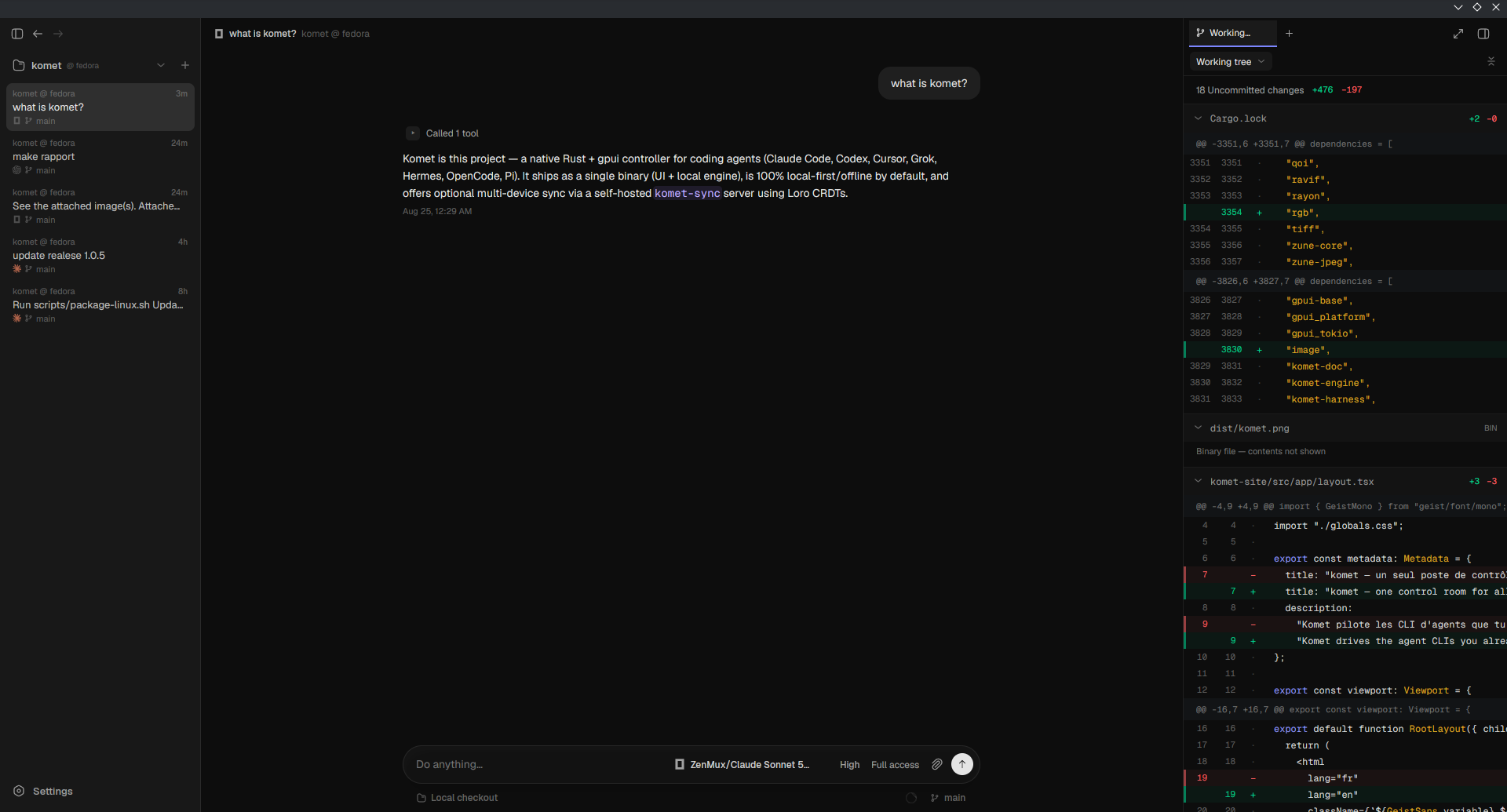
Rust + gpui, a single binary
The same engine that powers Zed. Instant launch, smooth scrolling even across years of transcripts, no Electron window to warm up.
Every agent, one timeline
Claude Code, Codex, Cursor, Devin, Grok, Hermes, Pi, OpenCode, Cline, Qoder, Antigravity, Muse and GitHub Copilot — each driven through its strongest native interface (stream-json, app-server, SDK shim, ACP or MSP), normalized into a single session model.
Rewind that keeps its promise
Every prompt drops a checkpoint on your worktree through a hidden git ref. Step back through the code and the conversation — not just the chat.
Built to never leave the keyboard
⌘N opens a session, ⏎ queues the next step while the agent works, ⌘⏎ steers mid-turn, Esc stops. No action ever requires the mouse.
Local by architecture, not by option
Projects, sessions, transcripts and credentials stay on disk. No account required, no telemetry, no cloud between you and your agents.
Multi-device when you decide
Self-hosted sync ships built in — Loro CRDT, per-device relay, your own server — but stays off by default. A VPS can keep your agents running while your laptop goes offline.
One command per platform.
Linux
Automatic install script, tarball, AppImage, .deb or .rpm package.
curl -fsSL https://raw.githubusercontent.com/jomvick/komet/main/install.sh | sh
macOS
Disk image (.dmg, Apple Silicon) or launchd service via the CLI.
komet daemon install
Windows
Standalone executable (.exe) or ready-to-use .zip archive.
komet.exe
All binaries (.tar.gz, .AppImage, .deb, .rpm, .dmg, .exe) are on GitHub Releases.
Your own VPS, in six cards.
komet serve runs the sync server and the engine in one process. Your desktop stays the controller — it never becomes a device in that workspace.
- 01
Prepare the box
Any always-on Linux machine. The binary needs gpui's shared libs even without a window — no display server — plus the agent CLIs you want to run there.
Debian / Ubuntu
sudo apt install libxcb1 libxkbcommon0 libxkbcommon-x11-0 libdbus-1-3
Fedora
sudo dnf install libxcb libxkbcommon libxkbcommon-x11 dbus-libs
- 02
Install it
One command installs the binary, generates the token in ~/.komet/serve.json, starts the systemd user service and prints a komet://pair/… link. --lan serves HTTP on your private network.
curl -fsSL https://raw.githubusercontent.com/jomvick/komet/main/install.sh | sh -s -- --serve --lan
- 03
Keep it alive
Without lingering the service stops with your session. On a home PC, also disable suspend — sessions die with the machine.
loginctl enable-linger $USER
- 04
Add TLS
Only if the desktop is not on the same LAN. Point a domain at the box, proxy to :8787, then save the public URL — or skip DNS entirely and pass the https URL a tunnel prints (instabox port publish, cloudflared). Skip on a trusted LAN.
komet serve --public-url https://sync.your-domain.com --install-service
- 05
Pair the desktop
Settings → Sync → Add device, paste the link. It is a secret: it grants a shell on that host. Lost it? komet serve --print-link.
- 06
Use and manage
Pick the machine in the Devices menu at the top of the sidebar: sessions run there, and Settings → Providers targets its agents. Restart after editing serve.json.
komet daemon status
komet daemon restart
Full reference, Fedora libs, Caddy config and teardown: docs/environments.md.

+ more agents coming
Drives what you already use
Komet is not a new agent. It drives Claude Code, Codex, Cursor, Devin, Grok, Hermes, Pi, OpenCode, Cline, Qoder, Antigravity, Muse and GitHub Copilot — the same sessions and tools you use every day, in one fast native window.
Star on GitHubWhat one agent learns, the next one knows
Komet keeps a local, allow-listed trace of every run — files touched, tool calls, failures, decisions — and hands it to the next agent as a briefing when it starts on the same project. Claude picks up where Codex stopped, without you retelling the story.
- —Event metadata only: never prompts, file contents or diffs.
- —SQLite + FTS5 on your disk, 180-day retention, no server.
- —Injected once at session start, capped at ~400 tokens.
Komet project memory — locally stored project context.
3 chat(s) across 2 agent(s).
- Codex — 2 runs, 41 tool calls, 2h ago; modified src/auth/session.rs
- Claude Code — 1 run, 12 tool calls, 1d ago; modified src/engine/run.rs
Known facts: auth uses the run journal [supported; source codex]
Refactor auth middleware
komet / web-app
Refactor the auth middleware and run the tests.
Claude Code
Split it into session and token modules. 3 files changed · tests pass
Codex
Added refresh-token rotation and its test. 1 file changed
Change the agent, keep the conversation
Thirteen agent CLIs in one window. Switch mid-chat and Komet writes a divider into the transcript, then runs the next turn on the new agent — same chat, same project, same memory.
13 agents · one timeline · switchable per chat
One binary. Your machine is home base.
Komet is a single Rust binary — the same engine runs headed in the window or headless on a server. Projects, sessions, shared memory and credentials live on your disk: no account, no telemetry, no cloud between you and your agents.
- —Works fully offline; SQLite store under your data directory.
- —Self-hosted sync built in — Loro CRDT, per-device relay, encrypted — off by default, enabled with komet sync-init.
- —Headless mode keeps agents running on a VPS while your laptop sleeps.
komet
one binary · headed or headless
komet
engine + ui
This machine
sessions · memory · credentials, on disk
Sync relay
Loro CRDT · encrypted · your server
Other device
VPS or second machine
Sync stays off until you point it at a VPS running the self-hosted sync server.
Know where the tokens went
Komet reads the token counters each CLI already writes on disk and totals them per agent, per model and per project — 24 hours, 7 days, 30 days. No API key, no billing access, nothing uploaded.
- —Measured turns and local logs, kept 180 days on your disk.
- —Quota windows and rate-limit rejections when the provider exposes them.
- —Cost is an estimate from a dated price table, never a bill. CSV export included.
Usage
13 agents · 30 days
Measured from each CLI's local logs · cost is an estimate, not a bill